Showing posts with label mike smith. Show all posts

Saturday, June 8, 2013

Palace Malice: A Heartwarming Belmont Victory

Racing enthusiasts spend months awaiting the Triple Crown, scouting talented young Thoroughbreds as they embark upon the search for the horse that can finally quench our thirst for a Triple Crown winner. And within a matter of five weeks – weeks that seem to pass within the blink of an eye – it is over.

Yet another year has passed without the capture of the coveted Triple Crown. For the sixth time in the past ten years, three different horses won each leg of the prestigious series, not only eliminating the dream of a Triple Crown triumph being achieved for the first time in thirty-five years, but discombobulating the three-year-old scene.

But one theme was recurrent throughout the 2013 Triple Crown: old-school. Beginning with Orb’s victory in the Kentucky Derby (GI) for the classic connections of Shug McGaughey and the Phipps and Janney families, the throwback feeling continued when Oxbow– ridden by Gary Stevens, trained by D. Wayne Lukas, and owned by Calumet Farm – upset the Preakness Stakes (GI).

The final leg of the Triple Crown, the Belmont Stakes (GI), was promoted as a rematch between the Derby and Preakness victors, but twelve additional Thoroughbreds aligned to contest against that pair to form the largest Belmont field since 1996. Among those fourteen starters, only three – Orb, Oxbow, and Will Take Charge – had contested in each jewel, but only four horses in the field had not contested in a single Triple Crown race. In fact, half of the field was directly exiting the Kentucky Derby.

Amid those horses was Palace Malice, the eccentric pacesetter of the Kentucky Derby. Equipped with blinkers for the first time in the Run for the Roses, the bay son of two-time Horse of the Year Curlin had essentially taken off with Hall of Fame rider Mike Smith, and after setting a blistering pace, he weakened to finish twelfth.

Palace Malice
Photo by Brittlan Wall
It was immediately decided that the blinkers would be taken off the Blue Grass Stakes (GI) runner-up. The colt departed the Derby in good order, working very well as he prepared for the Belmont Stakes, posting a trifecta of noteworthy breezes at Belmont Park as trainer Todd Pletcher looked on.

Palace Malice entered the Belmont under morning line odds of 15-1. Of Pletcher’s record five Belmont starters, the colt was the second-longest shot on the morning line. To the roar of more than 47,000 people gathered at the New York track, Palace Malice loaded into the twelfth stall alongside his rivals over a track that had dried enough to be labeled fast – a day after it had been an oval of slop.

Palace Malice broke well and Mike Smith immediately guided him to the vanguard, angling his mount closer to the inside as Preakness winner Oxbow also galloped to the front. Meanwhile, along the inside, Frac Daddy and Freedom Child also charged to the lead.

Racing wide around the wide clubhouse turn, Palace Malice was only a small matter of lengths behind the early leader, Frac Daddy. As a brisk initial quarter-mile of 23.11 was set, Palace Malice remained comfortable in a stalking position, edging closer to the front midway through the first curve. As Frac Daddy, Freedom Child, and Oxbow formed a cluster at the front of the pack, Palace Malice sat just behind them, inching closer as a half-mile clocking of 46.66 – the fastest since Secretariat’s record-breaking victory in 1973 – was recorded.

As Frac Daddy began to drop back, Oxbow seized the lead over Freedom Child, allowing Palace Malice to advance to the third position. Less than two lengths separated Palace Malice and Oxbow as the backstretch began to transform into the far turn. Threatening the Preakness victor on the outside, Palace Malice began to rally beneath a stationary Mike Smith, drawing even with Oxbow in the early stages of the final curve.

Palace Malice established a narrow advantage over Oxbow near the end of the far turn as the pair abandoned their remaining rivals by more than three lengths. Leading his thirteen opponents into the long, grueling stretch of Big Sandy, Palace Malice began to kick clear, opening up on Oxbow and the closers that were gradually gaining ground on the frontrunners.

This moment of drawing away proved crucial for Palace Malice, as he staggered home. However, the rest of the field did the same, allowing the bay colt to maintain his wide lead as he captured the 145th installment of the classic by 3 ¼ lengths. As trainer Todd Pletcher celebrated gleefully in the grandstand, Mike Smith galloped Palace Malice out with a euphoric grin upon his face, gazing up at the heavens as he pumped his fists victoriously. Meanwhile, Cot Campbell – president of Dogwood Stable, which owns Palace Malice – relished the victory, his first Triple Crown race win since Summer Squall carried the Dogwood green and yellow silks to victory in the 1990 Preakness.

The 2013 Triple Crown was over, but not without style. Old-school had reigned again, treating racing fans with a glimpse into the past.

Palace Malice
Photo by Brittlan Wall
While Pletcher may not appear to fit with the theme of old-school, it must not be forgotten that he is a former assistant to D. Wayne Lukas, having worked under “The Coach” for seven years. During this time, Pletcher was associated with the likes of Derby and Belmont winner Thunder Gulch, Breeders’ Cup Juvenile Fillies (GI) champion Flanders, and champion filly and winner of thirteen grade ones, Serena’s Song.

And although Mike Smith has graced many headlines in recent years – especially during his years of riding the popular Zenyatta– the 47-year-old jockey has made his name be known in racing since the early 1990s. Inducted into the Hall of Fame in 2003, Mike Smith had won one edition of each Triple Crown race prior to this year’s Belmont.

But the true old-school story that Palace Malice carried into the winner’s circle with the garland of carnations was that of Dogwood Stable. Founded in Aiken, South Carolina in 1973, Campbell’s Dogwood Stable has sent a plethora of high-caliber Thoroughbreds to the racetrack, including not only Summer Squall, but the Champion Two-Year-Old Filly of 1996, Storm Song. For 23 years, a Triple Crown race win had eluded the storied stable, but with two of the most recognizable faces in racing in Pletcher and Smith, Campbell was finally able to attain yet another victory in one of the sought-after spring classics.

After the race, 85-year-old Campbell, who had led his horse into the winner’s enclosure with a heartwarming smile upon his face, summed it up best: “This is the mother of all great moments, I’ll tell you that. I’m proud for Dogwood and for my great partners. . . And I’m proud for Aiken, South Carolina; they’ll be dancing in the streets. . . And I’m proud of Todd, one of the great trainers of all-time and Mike Smith, one of the great riders. And, for the horse, the horse, the horse! I’m so proud of him.”

While Palace Malice’s connections carry an old-school story, Palace Malice carries a story of fate. The dam of Palace Malice, Palace Rumor, was trained by small-time trainer Burl McBride, who sent the daughter of Royal Anthem to Hal Wiggins’ barn at Churchill Downs for a start beneath the twin spires in 2005 while the remainder of his small stable remained at Ellis Park. Although he planned to send Palace Rumor – two years old at the time – back to Ellis Park after her race, he decided to keep her overnight at Churchill following a taxing effort.

Early the next morning, a tornado ripped through Ellis Park, killing three of the seven horses McBride had stabled there. Palace Rumor – who, by the intervention of fate, had remained safe at Churchill Downs – was the only horse he had left. She would go on to be a black-type winner, accumulating career earnings of $271,135 before being sold for $140,000 to William S. Farish of Lane’s End Farm at the 2008 Keeneland January Horses of All Ages Sale while in foal to Tiznow.

One year later, Palace Rumor was bred to Curlin. The result was Palace Malice, who McBride attempted to purchase but was never able to, although he has eagerly followed the colt.

And so now, the colt who exists by the intervention of fate has won one of the greatest races in the United States for the trainer who learned the ropes from a Hall of Famer, for the Hall of Fame rider that had searched for redemption, and for the owner who truly loves the game and the animals that make the game what it is: the horses.

Palace Malice
Photo by Brittlan Wall

Friday, May 3, 2013

Princess of Sylmar Shocks the 139th Kentucky Oaks


Some of the best female racehorses in this era of girl power have captured the Kentucky Oaks (GI) in recent years. In 2007, Rags to Riches overwhelmed her rivals in the Kentucky Derby's (GI) sister race, which served as a prelude to her historic Belmont Stakes (GI) victory. Rachel Alexandra annihilated the Oaks field in 2009, conquering the race by 20 1/4 lengths, as part of her Horse of the Year campaign. A year later, Blind Luck provided fans with a thrilling edition of the Oaks, rallying to win by a nose.

This year marked the 139th installment of the Kentucky Oaks, which presented one of the most competitive fields in memory. But it wasn’t a favorite that was bestowed the garland of lilies; it was a 38-1 longshot: Princess of Sylmar.


Princess of Sylmar
Photo by Brittlan Wall
A Pennsylvania-bred daughter of Majestic Warrior, Princess of Sylmar hails from humble beginnings. A homebred for Ed Stanco of King of Prussia Stable, Princess of Sylmar was fourth in her debut at Penn National – a track that is not exactly heralded as a high-caliber track that produces classic winners.

But Princess of Sylmar soon let it be known that she is the type of horse that proves doubters wrong on a regular basis. In her second start, the chestnut filly demolished a maiden special weight at Penn National, crossing the wire an astounding 19 lengths ahead of her nearest rival. With her impressive triumph, it was on to Aqueduct in New York for the small chestnut filly.

Following a romp in an allowance optional claiming event, Princess of Sylmar entered stakes company. Her past two races – both of which she’d won in a breathtakingly easy manner – earned her respect in her black-type debut. She was sent off as the heavy favorite in her first two stakes races and lived up to her short odds, dominating the Busanda Stakes and the Busher Stakes at Aqueduct by a combined 14 ½ lengths.

The filly was riding a hot streak. She was proving herself to be a special filly, but as soon as she was beaten by Gulfstream Park shipper Close Hatches in the Gazelle Stakes (GII), a mass of people abandoned her bandwagon. A single loss had driven supporters away from her, allowing her to approach the Kentucky Oaks under the radar.

Her chances at taking home the “Lilies for the Fillies” seem to further diminish after her first work at Churchill Downs. The Todd Pletcher trainee appeared rather flat in her first breeze beneath the twin spires and less focus was put on her as race analysts paid more attention to the race’s favorites.

However, Princess of Sylmar rebounded in her second work over the track, breezing a half-mile in 49.20 seconds. She got over the track in a much flashier manner, suggesting that she was beginning to blossom. Still, few took notice.

When race day dawned, little attention remained on Princess of Sylmar, leading her to be sent off as the second-longest shot in the deep field of ten. Breaking from the sixth gate, Princess of Sylmar was involved in the wrestling match that occurred within the first few strides of the race, being squeezed by rivals and losing ground. She recovered quickly, but was left nearly eleven lengths behind the pacesetter, Midnight Lucky, by the end of the first quarter of a mile.

Finding a position just behind her favored stablemate, Dreaming of Julia, in ninth as the fillies entered the backstretch, Princess of Sylmar appeared very comfortable with Hall of Fame jockey Mike Smith aboard as Midnight Lucky set brisk fractions in the vanguard. Gradually, Princess of Sylmar made up ground, advancing between horses down the backstretch as Smith piloted her closer to the lead.

Racing three paths off the rail as the field entered the far turn, Princess of Sylmar had upgraded to fourth by the time the horses reached the three-eighths marker. Smith guided her into an even wider position, beginning to ask the filly to begin her rally as the horses neared the quarter pole. As Eclipse Champion Two-Year-Old Filly and Breeders’ Cup Juvenile Fillies (GI) victress Beholder stormed to the lead at the top of the stretch, Princess of Sylmar closed on the outside, steering around undefeated stablemate Unlimited Budget.

As the final furlong commenced, Princess of Sylmar found her best stride, drawing even with the frontrunners prior to surpassing Beholder within the final sixteenth, securing victory by a half-length as she switched leads at the finish. The filly had proved doubters wrong and achieved the impossible, taking on and defeating one of the toughest Oaks fields in history despite her long odds and peculiar path to Churchill Downs.

Princess of Sylmar’s Oaks win served as Mike Smith’s first triumph in the race and trainer Todd Pletcher’s third. Beholder, who had become worked up prior to the race and had even nearly fallen – dismounting jockey Garrett Gomez – in the post parade, performed valiantly to finish second in her attempt to become the first Breeders’ Cup Juvenile Fillies winner to capture the Oaks since Silverbulletday in 1999. Like Princess of Sylmar, the third- and fourth-place finishers – Unlimited Budget and Dreaming of Julia, respectively – were conditioned by Pletcher. Dreaming of Julia, also a victim of the vicious break, had received a very poor trip but made a gallant rally nonetheless.

There was very little focus on Princess of Sylmar prior to the Oaks, but at the culmination of the prestigious race, all attention was on the “fun-sized” filly. After the race, as Mike Smith was interviewed by NBC’s Donna Barton Brothers aboard Princess of Sylmar, he summarized the Kentucky Oaks winner perfectly, “She’s not very big, but she’s got a big heart.”

Mike Smith celebrating aboard Princess of Sylmar
Photo by Brittlan Wall

Friday, March 9, 2012

Zenyatta Delivers a Colt


A new life has been brought into world, and that is the life of the first foal of the great mare Zenyatta. In the hearts of racing and Zenyatta fans, such as me, the hope that the foal will be at least somewhat similar to Zenyatta soars feverishly. During her racing career, we watched Zenyatta fly past horses in late stretch twenty times, our eyes glued to her large, dark frame. The closer she grew to the wire, the louder we cheered and the faster our hearts beat. Now her life as a broodmare has brought us a different form of excitement: an eagerness for the dynasty of Zenyatta to begin.

At approximately 10:00 Eastern Time on March 8, 2012, Zenyatta gave birth to a dark bay colt weighing 130 pounds at Lane’s End Farm in Versailles, Kentucky. Not long after the great mare had foaled, official word, a photo, and a video were posted on the Zenyatta website, which can be reached here

Zenyatta's owners, Jerry and Ann Moss, were on site for the birth of the foal, having arrived at the farm days before the colt was born. It is expected that John and Dottie Shirreffs will arrive soon, as will Mike Smith, the jockey who rode the great mare in seventeen of her twenty starts.

As soon as word was released, racing fans were raving about Zenyatta and her new colt. This was not unlike any other time that exciting Zenyatta news was disclosed. Even in retirement, the 2010 Horse of the Year holds the key to the hearts of many racing fans. It is obvious that Zenyatta is one of the most popular horses of all-time and that she will continue to be.

Clearly, Zenyatta is one of the greatest racehorses ever to set foot on a racetrack. Her colt's sire, Bernardini, was one of the best sophomore runners of the past decade, being voted 2006 Champion Three-Year-Old Male after dominantly winning five graded stakes races – including the Preakness Stakes (GI), the Travers Stakes (GI), and the Jockey Club Gold Cup (GI) – by a combined 40 lengths. Furthermore, Bernardini has become one of the top sires in America. In fact, he is currently the third-leading North American sire by earnings.

Perhaps Zenyatta’s first foal will not live up to expectations, but like Rachel Alexandra’s colt born in January, he will be one of the most-loved horses of all-time. After all, he is the son of one of the most celebrated horses to ever look through a bridle. No matter what he achieves, there’s one thing no one can ever take away from him: he is the first offspring of the great Zenyatta. The colt, whether he ever wears a garland of flowers or not, is already a prince.


Zenyatta
Photo: Terri Cage

Remember to like Past the Grandstand on Facebook and follow Past the Grandstand on Twitter! Links can be found on the right side of the blog.

Wednesday, December 28, 2011

Opening Day at the Great Race Place

Around noon in Arcadia, California on the day after Christmas, over 44,000 people focused their eyes on the starting gate at Santa Anita Park. Suddenly, six two-year-old fillies broke from the gate in the California Breeders’ Champion Stakes. The winner, Ismene, was no surprise, as she went off as the heavy favorite. The undefeated filly galloped effortlessly to a near-three-length victory under Hall of Fame jockey Mike Smith. The opening day card at the Great Race Place had gotten off to a spectacular start, which was a hint at what was to come in later races.
Stakes action returned in the seventh race, the California Breeders’ Champion Stakes for juvenile males. Got Even, coming off a disappointing finish in the Generous Stakes (GIII) at Hollywood Park, dominated the race by 4 ¼ lengths at 12-1.
Mr. Commons
Photo by Mary Cage

In the next race, all eyes were on Mr. Commons, who was coming off a tough fifth in the Breeders’ Cup Mile (GI). The John Shirreffs trainee made a dazzling move as the horses neared the finish line, splitting horses in mid-stretch. The classy sun of the Breeder's Cup Mile-winning Artie Schiller accelerated beautifully, drawing off to win by 3 ¼ lengths under Mike Smith in an imposing final time of 1:33.94 for a mile on the turf. This colt is getting better and better and he absolutely blows me away with his class and the ease with which he wins races. He is rapidly improving and will be a force to be reckoned with in 2012.

The Factor
Photo: Terri Cage

After Mr. Commons’ dazzling victory came another scintillating performance. The last race on the card was the Malibu Stakes (GI) for three-year-old colts going seven furlongs. The Factor, a grade one winner, went off as the favorite despite a disappointing finish in the Breeders’ Cup Dirt Mile (GI) last out. However, the speedy Bob Baffert trainee had drawn the rail in his past two starts, but he was able to break on the outside this time around, which allowed him to have a better trip. The talented charcoal gray colt effortlessly won the grade one race by 3 ½ lengths, running the final sixteenth of a mile in an impressive 11.97 seconds and earning Hall of Fame trainer Bob Baffert his first win in the Malibu. The final time, 1:19.89, was just .19 seconds slower than the record set by Twirling Candy in the same race in 2010, which came on the same day The Factor broke his maiden in track record time for six furlongs. Centralinteligence appeared to jump something on the far turn, was eased by Joel Rosario, and seems to have come out of the race well despite the incident.

The Factor may travel to Meydan Racecourse to race in the $2 million Dubai Golden Shaheen on March 31, 2012 and Mr. Commons may return to dirt in the $200,000 Strub Stakes (GII) on February 4, 2012.


Monday’s racing at Santa Anita implied that the Great Race Place will have incredible racing for the rest of its meet, which stretches until April 22, 2012. The Strub Series should attract plenty of talented horses and the Arcadia track’s contentious three-year-old graded stakes series should provide plenty of excitement on the Kentucky Derby trail. With the San Gabriel Mountains directly across from the historic grandstand and brilliant horses competing on the track’s classy dirt and turf courses, Santa Anita should definitely live up to its nickname, the Great Race Place, yet again this meet.

Remember to like Past the Grandstand on Facebook and follow Past the Grandstand on Twitter! Links can be found on the right side of the blog.

Sunday, November 20, 2011

Drosselmeyer: From Racehorse to Stud

I can list them easily: Animal Kingdom, Awesome Feather, Blind Luck, Drosselmeyer, Euroears, My Miss Aurelia, Shackleford, Uncle Mo, Weemissfrankie, and Winter Memories. These are the horses of 2011 that captured my heart and had me screaming at the top of my lungs throughout the year. Some of them never got to show just how good they were, some of them couldn’t quite live up to expectations, and some of them flaunted their brilliance when it counted most. Drosselmeyer could be categorized in the latter group.
Photo by Mary Cage
It took Drosselmeyer a while to get going, but he finished up the year better than one could imagine by winning the Breeders’ Cup Classic (GI). As a two-year-old, Drosselmeyer broke his maiden in his fourth start, winning by six lengths at Churchill Downs. He then won an allowance by nearly two lengths at Gulfstream Park, defeating future grade one winners Prince Will I Am and Stately Victor, multiple graded stakes-placed Guys Reward, and stakes-placed No Shenanigans.
Kentucky Derby dreams had formed and the colt made his way to Louisiana for the Risen Star Stakes (GII). I’d heard of the colt and was eager to see how he would do. He made a rally on the inside to finish fourth behind Discreetly Mine. I wasn’t discouraged at all, as it didn’t seem like he’d enjoyed his trip along the rail.

Photo: Terri Cage
Yet that’s exactly what he had to deal with next out in the Louisiana Derby (GII). He rallied along the inside yet again and finished third. I still could tell he was still very talented and I hoped that he would have enough earnings to enter the Kentucky Derby. However, he fell short on the earnings list and was excluded from the Run for the Roses.

Prepping for the Belmont Stakes (GI), Drosselmeyer finished second behind Fly Down in the Dwyer Stakes (GII). Drosselmeyer may have been defeated by six lengths, but he also broke slowly and had traffic problems.
Four weeks later, the Belmont was a different story. Ridden by Hall of Fame jockey Mike Smith for the first time, Drosselmeyer emerged late on the outside to score a win in the Test of the Champion. Finally, the colt had been able to show the world just how talented he was.
After his Belmont win, Drosselmeyer injured his ankle and was out indefinitely. It broke my heart that the colt would be out, but I hoped that he would come back strong as a four-year-old.
While visiting Kentucky for the Breeders’ Cup last year, we stopped by WinStar Farm for a stallion tour. We were informed that Drosselmeyer was across the street at WinStar’s training facility. I ached to go over there to see the colt, but I knew I couldn’t and instead I just remained glad that he was doing well.

Photo: Terri Cage

After exactly nine months off, the striking chestnut son of Distorted Humor returned in the Challenger Stakes at Tampa Bay Downs, finishing fourth. After a disappointing fifth in the Skip Away Stakes (GIII) at Gulfstream Park, Drosselmeyer returned to his winning ways in the One Count Stakes at Belmont Park. Though it was just a $60,000 stakes race, he defeated eventual grade two winner Birdrun, grade three victor Inherit the Gold, multiple stakes winner Alma d’Oro, eventual Breeders’ Cup Marathon (GII) winner Afleet Again, and stakes-winning Edgewater.

Birdrun got revenge on him next out in the Brooklyn Handicap (GII), defeating him by nearly four lengths. Drosselmeyer then returned to the surface he’d run his first two career starts over: turf. In the Sword Dancer Invitational Stakes (GI), Drosselmeyer didn’t show much affinity for the grass and finished seventh.
Drosselmeyer returned to the dirt in his next race, the Jockey Club Gold Cup (GI). Having run mostly against marathon horses – which nowadays are not considered to be of the same class as horses that run a maximum of ten furlongs – prior to the prestigious race, not much attention was on Drosselmeyer. However, Drosselmeyer closed impressively on the outside to finish second, relishing being on the dirt again.
Photo by Mary Cage
As the 2011 Breeders’ Cup approached, I was mostly drawn to the star power. Attending morning workouts, I kept my eyes peeled for horses like Flat Out, Havre de Grace, and Uncle Mo. But when a gleaming golden chestnut stepped into my view and I read the name Drosselmeyer on the yellow saddle towel, my love for Drosselmeyer was renewed.
I was riveted by him once again. It was my first time to ever see him in person, so my eyes locked on him as he jogged alongside a pony horse. My heart thudded in my chest, my head turned as I followed him, and my camera clicked as I took pictures of him and videoed him. He looked spectacular. He carried himself with tremendous class, his coat shining liking a brand new penny and his legs moving so smoothly he could pass as a show horse. Sure, I was picking Flat Out on paper, but from appearances on the track in the morning, Drosselmeyer was my Classic horse.
So, as I stood along the rail near the winner’s circle and finish line during the Classic, my heart soared as Drosselmeyer flew along the outside, eclipsing the talented Classic field. I punched my fist into the air, letting out a shout of joy as Drosselmeyer, reunited with Mike Smith, galloped into the history books. I turned around to face my family, cheering one word with bliss: “Drosselmeyer!”
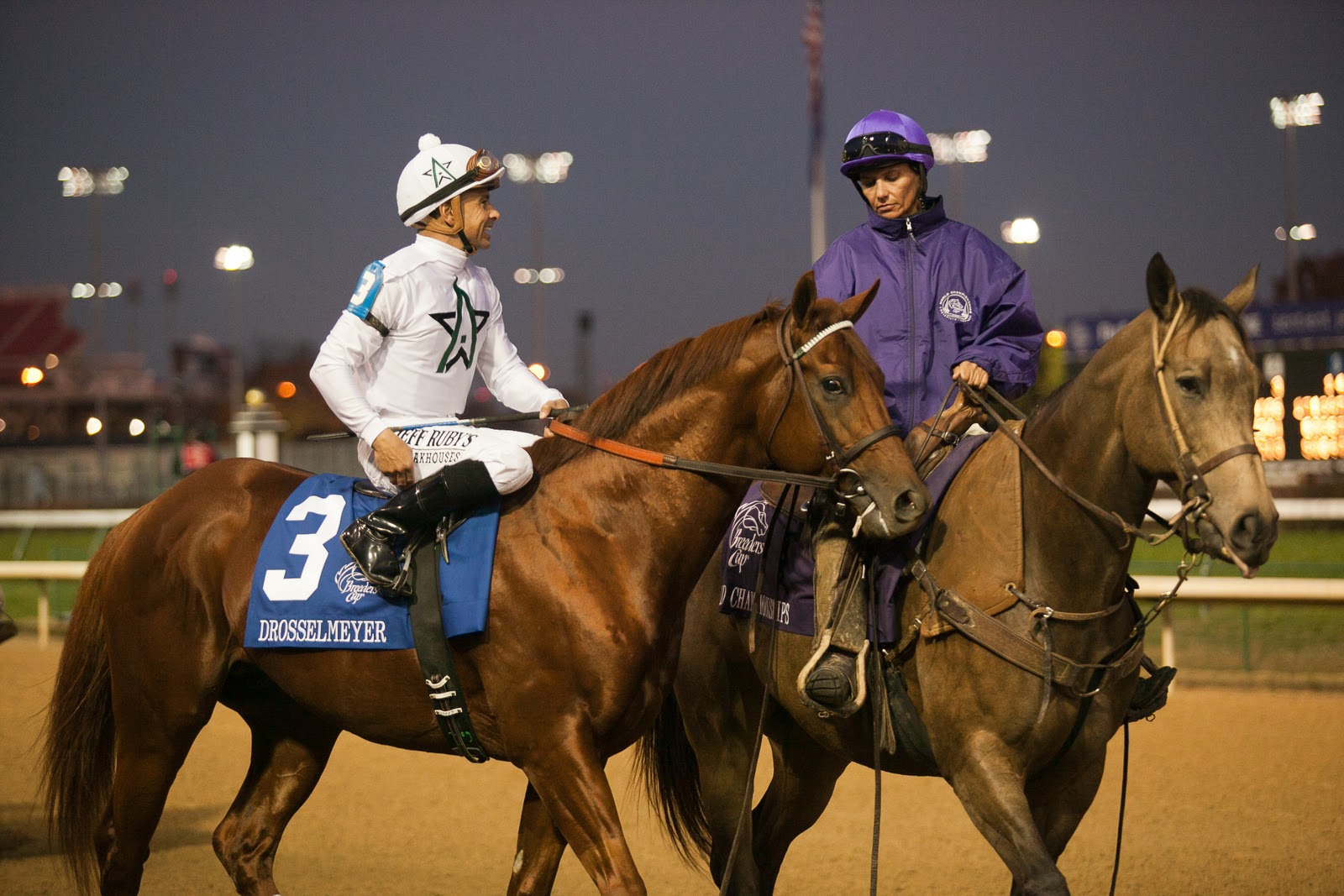
The colt soon jogged up with my favorite jockey, Mike Smith, aboard and I felt a grin stretch across my face as I recorded the horse entering the winner’s circle on my phone. Just feet from me, the stunning horse entered the winner’s circle under the Twin Spires. Not only was the Classic a story of redemption for Mike Smith (Drosselmeyer Dances Home in the Classic), but it was a story of redemption for Drosselmeyer.

Photo: Terri Cage
Just days prior to Drosselmeyer’s victory, I had visited WinStar Farm for the third time. We were told that the colt would go to New York for his stud career. My heart sank, knowing I’d better relish seeing him at the Breeders’ Cup, as I likely wouldn’t get to see him if he stood in New York.

But after his spectacular Classic win, WinStar faced a decision: should Drosselmeyer go to New York as planned or should he stay in Kentucky now that he’d won the Classic? A win in America’s richest horse race added another question: should he retire or should he continue racing?
I knew that if he was retired, he would go to stud in Kentucky. After all, he was a Belmont Stakes winner that had just won the Breeders’ Cup Classic. However, I didn’t want him to retire just yet. My love for Drosselmeyer had just escalated even more and I wanted to see him run another year.
But that wasn’t the case. On Friday, it was announced that Drosselmeyer was retired to stud at WinStar Farm in Kentucky. Understanding that right after winning the Breeders’ Cup Classic was a good time for him to enter stud, I was disappointed to know racing fans wouldn't get to enjoy him for another year. Yet, I look forward to visiting him at WinStar someday so I can reminisce on watching him race and can see that beautiful gleaming chestnut coat again.


Now Drosselmeyer will begin his new career alongside his sire, Distorted Humor, who is the leading sire in America. Distorted Humor has sired 42 stakes horses, including 17 stakes winners and 9 graded stakes winners. Ever since his first crop, he has sired at least 10 stakes winners a year and has produced an incredible 9 millionaires and 12 grade one winners. Big names he has sired include Kentucky Derby and Preakness winner Funny Cide, two-time Whitney Handicap (GI) winner Commentator, and Travers Stakes (GI) winner Flower Alley. Clearly, Distorted Humor is an incredible racing sire, but he is one of the best commercial sires at stud as well. In fact, he holds the highest three-year yearling average in the nation. Standing for $100,000, Distorted Humor is most definitely a force to be reckoned with.
Drosselmeyer’s dam side is definitely not lacking talent. His dam, Golden Ballet, is a multiple grade one winner and earner of $732,145. She obviously is a good producer, having produced Drosselmeyer, but he is not her only talented offspring. She has also produced Stage Luck, who won the Affectionately Handicap at Aqueduct prior to finishing third in the Rare Treat Handicap, fourth in the Next Move Handicap (GIII), and third in the Ruffian Handicap (GI).
A photo I absolutely love by Terri Cage
Tracing back to influential sires such as Northern Dancer, Seattle Slew, and Mr. Prospector, Drosselmeyer looks to be a successful stallion. His stud fee is set for $17,500. Before we know it, we’ll see little Drosselmeyers collecting prestigious victories.
And for now, as we wait for the breeding season to begin, we can muse over Drosselmeyer’s Classic victory. It was a race that will always be dear to my heart, a race that showed me redemption is possible, a race that evoked feelings of joy for me, and a race that I can always watch and say, “I was there. I was right there.”
Drosselmeyer on the track the Thursday before his Classic win
Video by Mary Cage
Drosselmeyer after winning the Classic
Video by Mary Cage

Remember to like Past the Grandstand on Facebook and follow Past the Grandstand on Twitter! Links can be found on the right side of the blog.

Wednesday, November 9, 2011

Breeders' Cup Wrap: Day Two (Beautiful Bluegrass: Day Four)


Afleet Again
Photo by Mary Cage

Day one of the Breeders’ Cup was over. It was Saturday and nine more championship races would be run. The Marathon kicked off Breeders’ Cup Saturday as 41-1 shot Afleet Again upset the mile and three-quarters race. I stood at the rim of the winner’s circle as the gray son of Afleet Alex entered the winner’s circle, snapping my pictures before the four-year-old gelding headed back to the barns.
After watching the Irish-bred Wrote cross the wire victoriously in the Juvenile Turf, I took a picture of the strikingly beautiful colt in the winner’s circle. Though the colt’s win was spectacular, my mind (and heart) was set on the next race.
Though I want to have a career in the racing business, I am a fan and horse lover first. I care more about the safety of and affection for the horse than anything. In the upcoming race, the Sprint, was one of my personal favorites, Euroears. However, it was not Euroears' day. Rather, the California-bred Amazombie came away with the win.

Euroears
Photo by Mary Cage

The sting of Euroears finishing last was eased slightly by the fact that my favorite jockey, Mike Smith, had pulled off the victory. His win in the Sprint gave him his fourteenth Breeders’ Cup triumph, which put him in second behind Jerry Bailey for the number of Breeders’ Cup wins.
The Turf Sprint, run in a final time of 56.48 for a distance of five furlongs, was won by Regally Ready. He became the only favorite to win on Saturday and gave jockey Corey Nakatani his second Breeders’ Cup victory of the weekend. Again, I stood alongside the winner’s circle as Regally Ready entered the winner’s circle, draped in a purple and gold blanket of flowers.
Next up was one of the Breeders’ Cup races I anticipated the most: the Dirt Mile. Shackleford, a colt I had followed since his maiden, fascinated me as he moved energetically through the post parade. Yet it was the very talented Caleb’s Posse that came away with the win, crossing the finish line four lengths ahead. I recorded him entering the winner’s circle prior to snapping pictures of him inside the winner’s enclosure.

A lily from St. Nicholas
Abbey's blanket of
flowers
Photo by Mary Cage
Then it was time for the Turf, which ended up being one of the most entertaining Breeders’ Cup races. Aidan O’Brien’s son, Joseph O’Brien, became the youngest jockey to ever be victorious in a Breeders’ Cup race when he won by over two lengths aboard St. Nicholas Abbey. At 5’11”, Joseph likely does not have much time left to ride flat races, but no matter how abbreviated his career, he will always have a Breeders’ Cup win under his belt. The race, which was already special, became even more special when I received a white lily that had fallen off of St. Nicholas Abbey’s blanket of flowers. Someday I hope to win an entire Breeders’ Cup blanket of flowers, but I can always look back and remember that I received a flower from one of those blankets.
Hansen
Photo by Mary Cage

When I look back on the 2011 Breeders’ Cup Juvenile, I smile and chuckle. At the same time, I get an earache. As the horses loaded into the starting gate, a large group of people appeared between our seats and the winner’s circle, standing just behind me. They screamed at the top of their lungs the entire race and by obtaining bits and pieces of their conversation, I realized they were cheering for Hansen. In a thrilling stretch duel, Hansen held off a drifting-out Union Rags. I was slightly upset that the Michael Matz trainee had not gotten up in time, in part because I had met Matz and received his autograph earlier that day, but the joy of the people around me wore off on me. Come to find out, they were part of Hansen’s connections.
As the next race approached, tension rose. Goldikova was going for her fourth straight Mile win. However, it was not meant to be. Court Vision narrowly pulled off a huge upset at 64-1, defeating Turallure by a slim nose. Goldikova crossed the wire in third, but an objection by Patrick Valenzuela aboard Courageous Cat was lodged against Olivier Peslier aboard the great mare. The stewards decided to make no change. The decision must have angered many bettors and connections, but when it was announced that no change would be made, a cheer went up from the crowd. Goldikova had already lost; her fans did not want to see her taken down.
As the sun sank lower and lower, the Classic horses made their way to the saddling paddock. Classy horse after classy horse passed me. My eyes locked on Havre de Grace, Uncle Mo, Flat Out, and Drosselmeyer. I began feeling extremely excited. I was seeking redemption from the year before, when I had witnessed with devastation Zenyatta fall short in the Classic.

Drosselmeyer
Photo: Terri Cage
It worked out beautifully. Drosselmeyer, who I had picked off of looks and class, swept by everyone in late stretch to win. As soon as the striking chestnut finished ahead of every horse, I pumped my fist in the air. I was trembling with bliss. Drosselmeyer had won! Redemption had come for not just me, but for Mike Smith as well. One year after Zenyatta’s heartbreaking loss, Drosselmeyer captured the $5 million race to give Mike Smith and many Zenyatta fans, including me, some consolation. Not only did the copper-colored Thoroughbred gallop into the history books, he galloped into my heart and ran a race that I will never forget and will always hold dear to my heart.

Drosselmeyer and Mike Smith after winning the Classic
Video by Mary Cage

Remember to like Past the Grandstand on Facebook and follow Past the Grandstand on Twitter! Links can be found on the right side of the blog.

Monday, November 7, 2011

Breeders' Cup Wrap: Day One (Beautiful Bluegrass: Day Three)

The track was very wet as the horses exercised over it early in the morning, jogging clockwise and galloping counter-clockwise. The Twin Spires loomed nearby as Breeders’ Cup horses made their final preparations over the track on Friday morning. I watched in awe of the famous Thoroughbreds until it was time to leave.
We weren’t going very far, though. We were soon in the Kentucky Derby Museum for the Zenyatta Luncheon. My excitement grew as I waited for the great mare’s connections to arrive and before long, I turned to see my favorite jockey, Mike Smith, standing just a few yards away. Finally, I would get to meet him in person.
I walked up to him, two Blood-Horse magazines with Zenyatta on the cover and a Sharpie in hand. After snapping a picture for him and his grandmother, he signed my magazines and I gave him a big hug, a gigantic grin stretching across my face and tears of joys filling my eyes. I never imagined I would get to receive an autograph and hug from Mike Smith.
My autographed Blood-Horse magazines
Photo by Mary Cage
Not long after I met Mike Smith, trainer John Shirreffs appeared. He kindly signed my Blood-Horse magazines and when I complimented him on Zenyatta, he simply said, “She’s just amazing, isn’t she?”
I later received autographs from Ann and Jerry Moss, as well as from Dottie Ingordo-Shirreffs. I was breathless the entire time. I’d dreamed of meeting Zenyatta’s connections, but I never imagined it would happen. Needless to say, I was on cloud nine.
Then it was time for the race card on the first day of Breeders’ Cup 2011 to get underway. My family and I headed to our seats, ready to watch some incredible racing. As we emerged from under the grandstand, I caught my breath. Straight across from me was the Kentucky Derby winner’s circle and just to my left was the main winner’s circle. As we were seated, I glanced behind me and looked up, only to be left even more breathless. It was one of the best views I’d ever seen. The Twin Spires were just above me.
After four non-Breeders’ Cup races, it was time for the Breeders’ Cup to begin. The first race of the world championships was one I was looking forward to the most: the inaugural running of the Breeders’ Cup Juvenile Sprint. The heavy favorite in the race was my favorite two-year-old, Secret Circle.

Secret Circle in the
post parade for
the Juvenile Sprint
Photo by Mary Cage

I had followed the colt since his maiden (Juvenile Spotlight: Secret Circle) and was looking forward to seeing him in person. Despite not handling the track that was labeled ‘good’ very well, Secret Circle defeated Shumoos by a length. I stood along the rail for the race, as well as while the bay colt entered the winner’s circle. It was thrilling to be so close to my favorite colt as he won the first Breeders’ Cup race of 2011.
In the next race, talented turf fillies took the stage in the Juvenile Fillies Turf. In that race, Stephanie’s Kitten got up in late stretch under John Velazquez to pass Stopshoppingmaria. I again watched from the edge of the winner’s circle, smiling as I saw the joyous celebration of the winning filly’s connections.
As the upcoming race, the Filly & Mare Sprint, approached, many thought it would be Turbulent Descent’s for the taking. However, it was Musical Romance that received the blanket of flowers. I had considered picking the Calder-based filly, but I guess the star potential of the other fillies got to me. Though it was surprising that Turbulent Descent finished fifth, it didn’t shock me at all that the 20-1 shot pulled off the upset.
With the next race came the appearance of a superstar. My Miss Aurelia, a filly I had followed since before her maiden race, defeated a talented field by three lengths. I already knew My Miss Aurelia would make a big impression, but after watching her win the Juvenile Fillies, I felt that she will become something very special.
The Filly & Mare Turf was quite similar to last year, resulting in a longshot taking the race. Perfect Shirl, under John Velazquez, held off several other females as the horses headed towards the wire to score the upset.

Royal Delta winning the Ladies' Classic
Photo: Terri Cage

Then it was time for Friday’s headliner. As the sun sank beyond the horizon and the bright lights shone down on Churchill, the field for the Ladies’ Classic headed towards the paddock. I stood along the rail, just a few feet from the classy fillies and mares that passed by me: Miss Match, Pachattack, It’s Tricky, Satans Quick Chick, Ask the Moon, Royal Delta, Ultra Blend, Plum Pretty, and Super Espresso.

In one of the most incredible racing moments I’ve witnessed in person, I stood along the rail near the finish line as Royal Delta easily swept past the other fillies and mares to win by 2 ½ lengths. It was one of the most effortless races of the weekend. I continued to stand at my spot along the rail, watching as the classy filly entered the winner’s circle just a few feet from me. Like many of the moments I had spent in Kentucky, the experience of being so close to Royal Delta before, during, and after the race was breathtaking.
Royal Delta after winning the Ladies' Classic
Video by Mary Cage

Remember to like Past the Grandstand on Facebook and follow Past the Grandstand on Twitter! Links can be found on the right side of the blog.

Saturday, November 5, 2011

Drosselmeyer Dances Home in the Classic

Last year, I watched in devastation as Zenyatta fell half a head short in the Breeders’ Cup Classic. As distraught as I was, it was nowhere near what Mike Smith must have felt. However, the 2011 Classic brought redemption for the Hall of Fame jockey.

Drosselmeyer on the track
Thursday morning

Photo by Mary Cage
On the Thursday before the Breeders’ Cup, Drosselmeyer was one of many Breeders’ Cup horses I saw out on the track in the morning. He blew me away with the class he carried, traveling down the track beautifully. I knew in that moment that the son of Distorted Humor would run a huge race. Click here to see the clip of Drosselmeyer on the track in the morning, along with video footage of other Breeders' Cup horses.

I saw him again on Friday morning and he still looked fit and composed. He was the most impressive of all the Classic horses I saw. I had Flat Out as number one on paper, but Drosselmeyer impressed me most with looks and class. I voted for him on Twitter to win, as he was definitely the most imposing Classic horse I saw on the track in the mornings. Throughout Breeders’ Cup weekend, I had the best feeling about Drosselmeyer and so it was no surprise to me that he crossed the wire first.

Photo: Terri Cage
Having to go extremely wide, Drosselmeyer flew on the outside, nearing the front runners just before the sixteenth pole. In a turn of events that even the makers of a movie couldn’t come up with, Mike Smith on Drosselmeyer passed his ex-fiance Chantal Sutherland on Game On Dude in the final strides. In a great call by Trevor Denman, he described Drosselmeyer as “a ghost on the outside.”
Of course, Drosselmeyer was best known before the Classic as the 2010 Belmont Stakes (GI) winner. Mike Smith also rode the striking chestnut in that race, recording his own Triple Crown. This win in the Classic obviously meant much to him after the heartbreak with Zenyatta last year. I’m overjoyed that Drosselmeyer and Mike Smith won and not just because I picked Drosselmeyer, but because it was just one day after I had met Mike Smith in person and had given him a big hug. It was wonderful to see my favorite jockey pull off the upset on one of my favorite horses in a race of redemption.

Drosselmeyer and Mike Smith after winning the Classic
Video by Mary Cage

Remember to like Past the Grandstand on Facebook and follow Past the Grandstand on Twitter! Links can be found on the right side of the blog.

Tuesday, October 18, 2011

Breeders' Cup Flashback: Zenyatta

It’s quite predictable that I would choose Zenyatta for my first Breeders’ Cup Flashback. She’s my favorite racehorse of all time and blew me away with all three of her Breeders’ Cup performances.
Zenyatta’s incredible Breeders’ Cup journey began in 2008, when as a four-year-old, the daughter of Street Cry was entered in the Breeders’ Cup Ladies’ Classic (GI). It was the first year the race was called the Ladies’ Classic rather than the Distaff.

Zenyatta
Photo: Terri Cage
Zenyatta was coming into the race with an undefeated record of eight wins. In her previous race, Zenyatta had easily defeated Hystericalady, who many actually picked over Zenyatta. Under Mike Smith, the half-sister to three-time grade one winner, Balance, effortlessly handed Hystericalady a defeat.

Zenyatta was the short-priced favorite in the Ladies’ Classic. Breaking from post position one, Mike Smith rode Zenyatta to a breathtaking win over Cocoa Beach. With an impressive final time of 1:46.85 for a mile and one-eighth, Zenyatta ran the final eighth of a mile in 11.73. The win secured her the Eclipse Award for older female.
As the 2009 Breeders’ Cup approached, the hype surrounded Zenyatta. People wondered if she would be entered in the Ladies’ Classic to defend her title or in the Classic to take on the males. Her connections chose the Classic.
It was a good choice. Zenyatta swept past the males in late stretch to defeat Gio Ponti by a length. It was an extraordinary performance, “one we’ll never forget.” The race gave me chills, leaving me breathless and screeching with joy. As soon as Zenyatta stuck her nose in front of Gio Ponti’s and galloped powerfully toward the wire, the 2009 Breeders’ Cup Classic became my favorite race of all time.
The 2010 Breeders’ Cup Classic had even more hype. It would be Zenyatta’s last race and the remarkable mare was looking to eclipse the consecutive wins record. If she won that year’s Classic, she would retire with twenty wins in twenty starts. Unfortunately, as I watched from under the Twin Spires, Zenyatta fell just half a head short to Blame.
However, her performance in the 2010 Classic was just as impressive as the 2009 Classic. Many even consider it to be more impressive. It didn’t take away from her greatness; it only solidified it.
Zenyatta ran with determination that made the ground shake. She ran with her heart and everything within her, striving to do her best. Zenyatta, though she won nineteen times in a row, didn’t run to win, but rather for the sheer joy of running. She didn’t just attract fans because of her thrilling victories, but because of her appealing personality. It’s not every day a horse like this comes along. It’s not even every year a horse like this comes along. So rejoice in what Zenyatta gave us. Zenyatta is one of the greatest racehorses of all time.


Remember to like Past the Grandstand on Facebook and follow Past the Grandstand on Twitter! Links can be found on the right side of the blog.