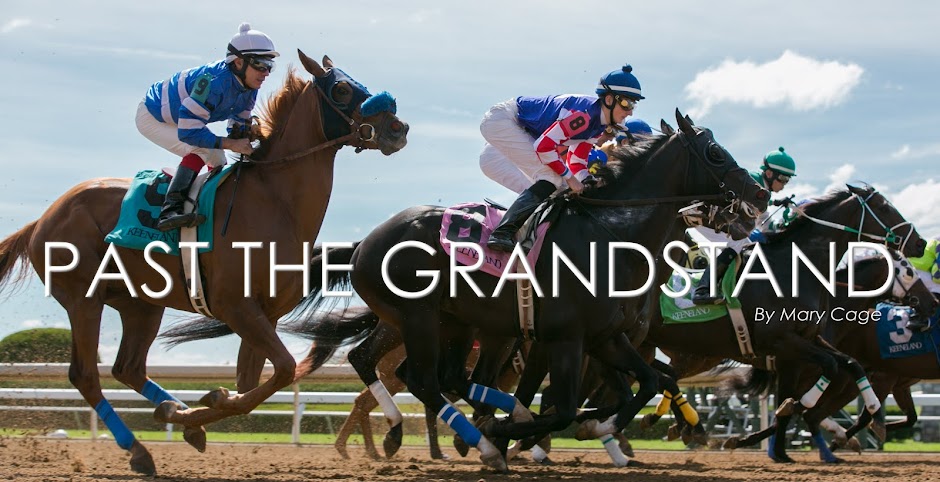
The sun has set on the 2011 racing season. It has been a year full of confusion, upsets, and more female superstardom. From the Triple Crown prep races in the first quarter of the year, to the Triple Crown, to the summer’s prestigious meets, to the Breeders' Cup prep races, to the Breeders’ Cup, and to post-Breeders’ Cup racing, Past the Grandstand is looking back on the racing of 2011.
I have described at least one racing highlight of each month:
 |
| Amazombie Photo by Mary Cage |
February: Prior to his Clark Handicap (GI) victory via disqualification in November of 2010, Giant Oak had always been considered as a horse that never quite got there. Yet the tall chestnut horse made it consecutive grade one wins when he won the Donn Handicap (GI) at Gulfstream Park on February 5 by two lengths.
March: Game on Dude broke onto the national scene in a controversial Santa Anita Handicap (GI). After a severe bumping incident at the top of the stretch between Game on Dude, Twirling Candy, and Setsuko, the Bob Baffert trainee went on to narrowly defeat Setsuko and survived a long review by the stewards. The win allowed Chantal Sutherland to be the first-ever female jockey to win the prestigious race. The win was just the beginning of an incredible year for the team.
April: Kentucky Derby preps wrapped up in April. Dialed In narrowly won the Florida Derby (GI) over Shackleford, Toby’s Corner upset Uncle Mo in the Wood Memorial Stakes (GI), Midnight Interlude surprised many in the Santa Anita Derby (GI), Brilliant Speed pulled an upset in the Blue Grass Stakes (GI), Archarcharch touchingly won the Arkansas Derby (GI), and Derby Kitten won the Lexington Stakes (GIII) for the Ramseys.
Havre de Grace earned her first grade one victory in the Apple Blossom Handicap (GI) at Oaklawn Park. With her triumph, racing fans got a taste of what to expect from the talented filly throughout the rest of the year.
 |
| Plum Pretty Photo: Terri Cage |
May: Bob Baffert had not been victorious in the Kentucky Oaks (GI) since 1999 when the Hall of Famer, Silverbulletday, won the Lilies for the Fillies. However, that all changed when Plum Pretty won the Kentucky Oaks on the Friday before the Kentucky Derby (GI). In the final yards of the race, the daughter of Medaglia d’Oro held off a valiant charge by St. John’s River. Had St. John’s River won, jockey Rosie Napravnik would have become the first female jockey to ever win the esteemed race.
The day after the Oaks was the first Saturday of May, otherwise known as Derby Day. Dialed In was sent off as the favorite in the Run for the Roses, but it was Animal Kingdom that wore the garland of roses at Churchill Downs. Despite being sent off at odds of nearly 21-1, Animal Kingdom impressed many with his triumph and as always after the Kentucky Derby, Triple Crown dreams soared.
However, a colt I have followed since his maiden, Shackleford, denied Animal Kingdom the Triple Crown when the son of Forestry gamely won the Preakness Stakes (GI). Despite running a terrific fourth in the Derby, Shackleford went off at odds of 12-1. His odds might have risen due to his boisterous behavior in the post parade, but he proved doubters wrong and earned the classic victory.
June: Ruler on Ice ended the 2011 Triple Crown with a longshot victory in the Belmont Stakes (GI). When Animal Kingdom was practically wiped out at the start, the race was over for the Derby winner. With Ruler on Ice as the Belmont victor, all three 2011 Triple Crown race winners were longshot chestnuts that provided their trainers with their first Triple Crown race wins.
Inglorious won the Woodbine Oaks before defeating the males in the Queen’s Plate Stakes – the first leg of the Canadian Triple Crown. She became the fifth filly to ever win both the Woodbine Oaks and the Queen’s Plate.
 |
| Blind Luck Photo by Mary Cage |
July: The prestigious Saratoga and Del Mar meets opened, providing racing fans with the opportunity to witness some of the classiest horses in the country and brilliant two-year-olds. From Acclamation’s second grade one win of the year in the Eddie Read Stakes (GI) to Stay Thirsty’s dominant breakthrough victory in the Jim Dandy Stakes (GII), the Saratoga and Del Mar meets got off to a great start.
We also saw what many consider the race of the year in the showdown between Blind Luck and likely 2011 Horse of the Year, Havre de Grace, in the Delaware Handicap (GII). Blind Luck edged out Havre de Grace by a nose in their final meeting, which made it the fourth time in their six meetings that the chestnut daughter of Pollard’s Vision finished in front of Havre de Grace. In my eyes, since it was such an exciting race that lived up to its hype, it was the race of the year.
August: August was a great month for racing. On Arlington Million Day, racing fans saw the talent of many classy turf horses, including Cape Blanco when he won the prestigious Arlington Million Stakes (GI). A week later, we got a taste of Royal Delta’s brilliance when she dominantly won the TVG Alabama Stakes (GI) at Saratoga. One week after her win, Saratoga put on another show as Uncle Mo made his comeback, falling short to Caleb’s Posse in the Foxwoods King Bishop Stakes (GI). Later in the day, Stay Thirsty made it back-to-back victories when he won the Travers Stakes (GI). To cap off a great month of racing, Acclamation rolled to his third straight grade one victory in the TVG Pacific Classic Stakes (GI).
*Past the Grandstand got its start!
 |
| Havre de Grace Photo: Terri Cage |
September: September got off to a great start. Havre de Grace continued the trend of girl power by trumping the boys in the Woodward Stakes (GI) at Saratoga. In doing so, she defeated top male Flat Out, as well as six other accomplished males. The last time her connections had raced a talented female against males in a prestigious race, it had ended in disaster when Eight Belles was euthanized due to injuries sustained after finishing second in the 2008 Kentucky Derby (GI). This time, though, Larry Jones’ and Rick Porter’s super filly won gloriously, coming out of the race sound.
The Kentucky Cup made its return with WinStar Farm as the presenting sponsor. Though the highlighted race was the WinStar Kentucky Cup Stakes (GII), it was the Bluegrass Cat Kentucky Cup Juvenile Stakes that many will remember the renewal of the Kentucky Cup for. Hansen won the race by 13 ¼ lengths before going on to win the Breeders’ Cup Juvenile (GI).
October: Belmont’s Super Saturday on the first day of October lived up to its name despite the dreary weather. Stacelita rounded up her second grade one victory of the year in the Flower Bowl Invitational Stakes (GI), Cape Blanco completed his career in an exciting victory over Dean’s Kitten in the Joe Hirsch Turf Classic Invitational Stakes (GI), Giant Ryan made it six straights wins in crossing the wire victoriously in the Vosburgh Invitational Stakes (GI), Uncle Mo showed his brilliance in the Kelso Handicap (GII), Havre de Grace dominated the Beldame Invitational Stakes (GI), and Flat Out earned his first grade one victory in the Jockey Club Gold Cup Stakes (GI).
Keeneland’s prestigious fall meet displayed top class horses yet again, including Gio Ponti’s final victory when he won the Shadwell Turf Mile Stakes (GI). Santa Anita flaunted talented horses in graded races as always, including Game on Dude’s triumph in the Goodwood Stakes (GI) and Weemissfrankie’s stirring win in the Oak Leaf Stakes (GI).
 |
| Bill Mott, Mike Smith, and Drosselmeyer after winning the Breeders' Cup Classic Photo: Terri Cage |
November: Of course, the highlight of November was the 28th running of the Breeders’ Cup World Championships. To my delight, I was in the midst of all the action, watching works in the morning and standing near the rail as horses won the championship races and entered the winner’s circle. My favorite two-year-old colt, Secret Circle, won the inaugural Breeders’ Cup Juvenile Sprint to kick off the two-day event. It was a championship event full of longshot victories, though superstar favorites like My Miss Aurelia, Royal Delta, and Regally Ready pulled through. Goldikova made her fourth Breeders’ Cup appearance and though she didn’t get the win, she brought plenty of smiles to racing fans. Uncle Mo’s story didn’t play out in fairytale fashion, but like Goldikova, the colt brought happiness to racing enthusiasts. I will never forget standing along the rail near the finish line and winner’s enclosure for some of the most prestigious races in the world, most notably Royal Delta's triumph in the Breeders’ Cup Ladies’ Classic (GI) and Drosselmeyer's incredible victory in the Breeders Cup’ Classic (GI).
Though overshadowed by the Breeders’ Cup, Aqueduct came through with notable grade one races: the Cigar Mile Handicap (GI) and the Gazelle Stakes (GI). To Honor and Serve, a colt I have followed since he broke his maiden, came away with an impressive victory in the Cigar Mile. Awesome Feather, a filly I have adored since before her 2010 Breeders’ Cup Juvenile Fillies (GI) victory, ran her record to eight-for-eight in the Gazelle.
December: December is a very dull month for racing, but California gave us grade ones to enjoy. There was Killer Graces victory in the Hollywood Starlet Stakes (GI), Liaision’s win in the CashCall Futurity (GI) to commemorate his late sire, and The Factor's triumph in the Malibu Stakes (GI). On New Year’s Eve, the California racing circuit will provide racing fans with the final grade one of the year in the La Brea Stakes (GI).
And of course, Rapid Redux tied the record for the number of single season victories, recording his nineteenth victory of 2011 while running his winning streak to 21.
2011 was a different type of year than the past few years. In 2007, we saw absolutely brilliant three-year-olds in Curlin, Hard Spun, Rags to Riches, Street Sense, and Octave. In 2008, we witnessed the dazzling Big Brown and the continuance of Curlin’s spectacular career and came to know the great Zenyatta. In 2009, we became spoiled with girl power with Rachel Alexandra’s and Zenyatta’s campaigns and were even treated with a very talented sophomore in Summer Bird. In 2010, the year was all about the all-time great Zenyatta. We weren’t as spoiled this year, but we did witness some great racing moments that we’ve never seen before. 2011 belonged to Uncle Mo’s comeback, Havre de Grace’s continuance of girl power, Rapid Redux’s incredible win streak, incredible turf horses such as Acclamation and Cape Blanco, imposing juveniles, and most of all, a lot of longshot victories.
 |
| Shackleford Photo: Terri Cage |
And so we move on to 2012, where we’ll see the return of Animal Kingdom and many soon-to-be four-year-olds. On the international scene, we can continue to watch the incredible Frankel and Black Caviar, who will both hopefully maintain their perferct records. Next year’s older male division should be much better than this year’s with the addition of Animal Kingdom, Caleb’s Posse, Mucho Macho Man, Ruler on Ice, Shackleford, Stay Thirsty, To Honor and Serve, and many others. Finally, we have several top sophomores continuing their racing careers into their four-year-old years. In fact, all three 2011 Triple Crown race winners and the three horses that competed in each of the Triple Crown races are expected to come back for a 2012 campaign. How great is that!
The 2012 three-year-old division is looking incredible with the likes of Creative Cause, Discreet Dancer, Gemologist, Hansen, Hierro, Liaison, Secret Circle, Union Rags, and several others.
I also expect girl power to continue next year. Havre de Grace is returning for a five-year-old campaign, Royal Delta is still in Bill Mott’s hands and is even being pointed toward the $1o million Dubai World Cup (GI), superfilly My Miss Aurelia will look to maintain her undefeated record as she points toward prestigious races such as the Kentucky Oaks (GI), and the wonderful Awesome Feather will look to remain perfect and obtain more grade one victories.
Goodbye, 2011. Hello, 2012!
Remember to like Past the Grandstand on Facebook and follow Past the Grandstand on Twitter! Links can be found on the right side of the blog.
Remember to like Past the Grandstand on Facebook and follow Past the Grandstand on Twitter! Links can be found on the right side of the blog.


