Showing posts with label smarty jones. Show all posts

Sunday, June 17, 2012

One Loss Wonders


They’re the races that pain us to watch again, the races that many devoted fans refuse to re-watch, the races that broke our hearts. Whether it was a demolishment or a photo finish, the sole defeat of an otherwise undefeated horse is always a sore spot for loving fans of such a Thoroughbred. We’ve had our fair share of near-undefeated horses recently, but there have been other horses of that sort in the past as well. One thing about these horses is certain: they were among the most popular racehorses of all-time. Here is a look at some of the “One Loss Wonders” of racing’s past:

Zenyatta:
The great mare did not begin her career until Thanksgiving Day of her three-year-old career and after winning a maiden and an allowance, Zenyatta went into 2008 with two wins in just as many starts. She posted victory after victory, winning four grade ones that year, including the Breeders’ Cup Ladies’ Classic (GI). A year later, the “Dancing Queen” captured yet another four grade ones, becoming the only female racehorse in history to win the prestigious Breeders’ Cup Classic (GI).
Zenyatta
Photo by Terri Cage

In 2010, Zenyatta was brought out of a very brief retirement to have one more year at the races. She continued to reel off wins, earning five more grade one triumphs as she ran her record to nineteen-for-nineteen, which, at the time, was tied with Peppers Pride for number of consecutive wins in modern-day North American racing. Her final start was the Breeders’ Cup Classic (GI), a race full of possibilities for the great mare. A win would not only secure her immortality for becoming the only horse to go undefeated in twenty career starts, but she would also be just the second horse to win three times at the Breeders’ Cup – Goldikova had amassed that achievement earlier in the day – and also only the second racehorse to ever win the Classic twice.

Of the six losses discussed in this blog, this was the only one I was present for. That, combined with the fact that Zenyatta is my favorite racehorse of all-time, leads the loss to hit home for me. Zenyatta broke slowly from the gate at Churchill Downs – normal for her, but more detrimental than any other time she’d come out of the starting gate slowly. She never appeared comfortable as she galloped over a surface over which she’d never raced, seeming to dislike the kickback that flew towards her. Zenyatta made a valiant rally under Hall of Fame rider Mike Smith, maneuvering traffic and charging like a freight train on the outside to miss defeating Blame by an official margin of a head, her head bobbing past him just after they flashed under the wire. It was certainly a race for the ages, but it was also one of the most heartrending races of all-time. It was a race that sent me rushing out of the grandstand before anyone could stop me, leaving me absolutely heartbroken. All along, I knew I wasn’t the only one left with a broken heart following the race.

Big Brown: He’d only raced three times going into the Kentucky Derby (GI), but each of those races – which resulted in wins – were monster performances. He’d won those three races by a combined winning margin of 29 lengths. As the favorite in the Derby, Big Brown cruised to a 4 ¾-length victory. With his impressive victory in the Derby, hopes were high as he continued on to the second leg of the Triple Crown, the Preakness Stakes (GI). Yet again, the colt turned in a fantastic performance, crossing the wire 5 ¼ lengths ahead. The confidence invested in Big Brown as he proceeded to the Belmont Stakes (GI) in pursuit of becoming the twelfth Triple Crown winner soared. The racing world was nearly certain that Big Brown was the one.

However, nothing seemed to go right at the Belmont. Big Brown had recently suffered one of his infamous quarter cracks, though his connections assured the media the colt was fine. On race day, the colt was uneasy in the detention barn and as the field warmed up for the twelve-furlong race, the colt was lathered in sweat, clearly affected by the heat and humidity. The race was over from the start. His shoe was partly dislodged from his right hind hoof at the beginning of the race, leaving it only partially on as he embarked on the twelve-furlong journey – something that surely was uncomfortable for the colt. Big Brown appeared rather rank throughout the race, though he eventually seemed to find the perfect stalking position. But the normal Big Brown did not show up. Fans were used to seeing the colt loom on the outside on the far turn as jockey Kent Desormeaux sat as still as a statue prior to opening up on the field. Rather, Desormeaux began urging the colt with a half-mile remaining, getting no response from the Derby and Preakness winner. Then came the worst part of the race: Big Brown was eased.

The colt emerged from the race sound, leaving fans devastated by his abnormal, shocking loss. But he returned later that year to win his last two starts, the Haskell Invitational Stakes (GI) and the Monmouth Stakes in New Jersey. He was expected to compete in the Breeders’ Cup Classic (GI) in the fall at Santa Anita, but a hoof injury forced his retirement. Despite his short career, unpopular connections, and distressing Belmont loss, Big Brown had rallied fans to become one of the most popular racehorses of the past decade.
Smarty Jones
Photo by Terri Cage


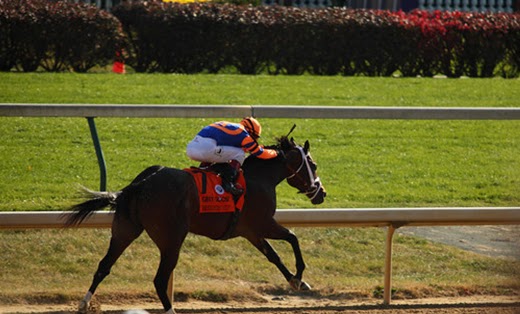
Smarty Jones: Despite his undefeated record that included a win in the Arkansas Derby (GII), Smarty Jones had plenty of doubters when he went to post in the Kentucky Derby. Over a very sloppy track, Smarty Jones settled off the pace set by Lion Heart before pouncing on the leader as the two turned for home. He hooked up with Lion Heart at the top of the stretch before looking the horse in the eye and galloping away to a 2 ¾-length victory. In the Preakness, Smarty blew his fans away by thundering to a dazzling 11 ½-length triumph, the largest winning margin in the history of the race.

It seemed as if we would finally see the first Triple Crown winner in twenty-six years. As the Belmont approached, fans were eager for Smarty Jones’ bid for the Triple Crown. As the horses turned for home and continued down the stretch at Belmont, Smarty seemed to have the win. But Birdstone caught up to the determined and exhausted colt, sweeping past him to win by just one length.

Smarty Jones was retired months after the Belmont, which ended up being his last race, due to bone bruises. Though his loss was heartbreaking, it displayed how elusive the title of Triple Crown winner is, how much love a nation can share for a horse, and that things can’t always be perfect. It also made it evident that Smarty Jones was a horse that never gave up.

Brigadier Gerard: As a juvenile, the British Thoroughbred won each of his four starts. He made his initial sophomore start in the first leg of the English Triple Crown, the 2,000 Guineas Stakes, winning the prestigious classic by three lengths. He added five more wins to his credit in just as many starts, dominating prestigious races throughout Great Britain. By the end of his three-year-old career, Brigadier had run his perfect record to ten races. As a four-year-old, Brigadier kicked off his final racing campaign with victories in five renowned races. The bay colt appeared unbeatable.

But when he started in the Benson & Hedges Gold Cup in his sixth start as a four-year-old, he was going ten furlongs – a distance he had won at before, but not one he really had an affinity for. Facing the Epsom Derby victor, Roberto, Brigadier Gerard was left behind as the champion colt led the field throughout, drawing off to an easy win that left Brigadier Gerard with the taste of defeat for the first and only time of his career.

Brigadier Gerard, however, returned to his winning ways, capturing two more renowned races – the Queen Elizabeth II Stakes and the Champion Stakes – while forming a new course record along the way. Despite his loss, he garnered the title of British Horse of the Year. Though he had a blemish in his record from his sole defeat, Brigadier Gerard retired with a nearly flawless record and is remembered as one of the best racehorses Britain has ever seen.

Majestic Prince:
The son of Raise a Native entered the Kentucky Derby with an undefeated record on the line, being sent off as the favorite despite a deep field that included Arts and Letters and Top Knight. Down the stretch, Majestic Prince battled Arts and Letters in a thrilling stretch duel prior to prevailing by a neck. The rivals duked it out yet again in the Preakness when Arts and Letters loomed on Majestic Prince’s outside in the stretch. The Derby winner had enough to hold off the great Arts and Letters by a head to score his ninth straight victory.

When Majestic Prince displayed a tendon issue following the Preakness, it was debated whether or not he would go for the Triple Crown in the Belmont Stakes. But the decision was made that the dual classic victor would go for the feat that hadn’t been accomplished in twenty-one years despite not being at his best. It cost him. Majestic Prince was defeated by his rival Arts and Letters by 5 ½ lengths in the Belmont to lose not only the Triple Crown, but the first and last race he would ever lose.

The popular colt never raced again after the Belmont, in which he joined a large assembly of horses that won the Kentucky Derby and Preakness but did not succeed in the Belmont. Ironically, a similar situation played out in this year's Triple Crown when I'll Have Another was diagnosed with a tendon issue prior to what would have been a Triple Crown attempt in the Belmont. However, unlike Majestic Prince, I'll Have Another was scratched.   

Native Dancer:
As a two-year-old, Native Dancer captured all nine of his races and even set a world record time for six and one-half furlongs while doing so. He was honored as 1952 Champion Two-Year-Old Male as a result of his spectacular juvenile campaign. Following wins in the Gotham Stakes and Wood Memorial, Native Dancer went to post in the greatest race of the year and one he was expected to win, the Kentucky Derby.

But following a bit of a slow break, Native Dancer found himself behind a wall of horses as the field galloped into the clubhouse turn. On that curve, the Dancer was interfered with and forced to check, but found a good position after the incident. But later in the race, Native Dancer faced yet another wall of horses. After maneuvering traffic, Native Dancer set his sights on the leader, Dark Star, and despite rallying, he finished a head behind Dark Star to post his only loss in his career and a defeat in the most important race of the year.

Native Dancer’s loss hung like a dark, sad cloud over racing fans. This horse had been expected to win the Triple Crown, but by losing the Derby, he had not shot at doing so. Though his wins in the Preakness and Belmont were joyous to racing fans, they were also bittersweet, as the Dancer was just a scant head away from being a Triple Crown victor. After the Derby, Native Dancer never lost again, capturing nine more victories. His Derby loss remains a heartbreaker for his adoring fans, but what he couldn’t accomplish on the track, he made up for in the breeding shed, siring the winner of the 1966 Kentucky Derby. In fact, nineteen Derby victors have descended from the Native Dancer sire line.

Man O’ War:
Within a span of about two months, Man O’ War won all six of his initial six starts, many of which were won by substantial margins. He was viewed as the top juvenile colt in the nation, having won stakes at four different tracks in New York in impressive fashion. In his second start at Saratoga, the chestnut colt went to post in the Sanford.

Also in the field was a colt named Upset, a horse Man O’ War had faced before, even giving fifteen pounds to the son of Whisk Broom. Yet again, Man O’ War carried fifteen more pounds than the chestnut with three white stockings. Many accounts say that Man O’ War was facing the opposite way when the race began, giving him a huge disadvantage. Johnny Loftus guided the horse throughout the race, but Man O’ War became boxed in with just a furlong left of the race. The young jockey angled the brilliant colt to the outside and the two rallied, but Man O’ War came up a half-length short of Upset to record the only loss of his career.

Man O’ War’s defeat was a crushing loss, but the colt rebounded and never lost again, capturing many prestigious races, including the Preakness Stakes, Belmont Stakes, Travers Stakes, and Jockey Club Gold Cup. The son of Fair Play is still considered by many to be the greatest racehorse of all-time. He may not have been undefeated, but his loss left not only an everlasting effect on horse racing, but on sports in general. The term upset, used when the favorite – or the competitor/team expected to win – is defeated by one expected to lose, derived from the name of the single horse to ever defeat the great Man O’ War.

Sysonby:
This horse won his first four starts with breathtaking ease. In fact, he’d won them by a combined twenty-two lengths. He was deemed unbeatable, and certainly the best juvenile in the country.

Everyone expected for the bay colt to win his fifth start, the 1904 Futurity Stakes at Sheepshead Bay, in spite of having to carry 127 pounds as the highweight in a deep field. But Sysonby was defeated by a substantial margin as the eventual champion filly Artful galloped to victory. Many were stunned that Sysonby had been defeated, but a groom that worked for his owner, James Keene, confessed that he had drugged the colt as part of a bribe.

Sysonby’s sound but understood, valiant defeat remained the only blemish on his record as the bay horse went on to win the rest of his starts, though one victory came in a dead heat in the Metropolitan Handicap. By the end of his career, Sysonby had won fourteen of fifteen career starts. Unfortunately, the colt’s career came to a tragic end when he died at the age of four due to variola. His popularity was evident when the horse was buried, as more than four thousand people attended the event, bidding their farewells to the brilliant horse.


The losses of these horses may have left their fans feeling heartbroken and crushed, but for many of them, it also solidified their greatness. It proved that not even the best are perfect, and even without perfect racing records, these horses were flawless in their fans’ hearts and minds. 


Remember to like Past the Grandstand on Facebook and follow Past the Grandstand on Twitter! Links can be found on the right side of the blog.

Friday, December 30, 2011

No Fans, No Sport

Horse racing used to be an extremely popular sport nationwide. Gigantic crowds graced the racetracks and fans tuned into the radio to listen to major races. Now, extremely large crowds are often only at the most prestigious races: the Triple Crown races and the Breeders’ Cup. The Kentucky Derby is the only race many people I know are familiar with. Only a few people I know that are outside the realm of horses have heard of the Preakness, Belmont, and the Breeders’ Cup.  They definitely don’t know the Santa Anita Handicap (GI), the Stephen Foster Handicap (GI), the Jockey Club Gold Cup (GI), or any other race for that matter. They know the names of Secretariat and Seabiscuit because of the movies and they might possibly know who Zenyatta is. As someone who is absolutely enthralled by horse racing, I get a sinking feeling when I realize how many people don’t know about the wonderful sport.
Photo: Terri Cage
Of course, horses like Barbaro, Funny Cide, Rachel Alexandra, Smarty Jones, and Zenyatta have together attracted thousands of new fans to the sport, but horse racing still lacks many fans. With less people attending the races, handle slides. When handle slides, the sport slides.
We need fans. Obviously, we have diehard fans and fans that are becoming fascinated by the sport. It’s those fans that need to inform others about horse racing.
The first direction those fans should go in is toward horse lovers and sports fans. Most horse lovers will be drawn to the sport because of the beautiful animals that strive to cross the wire first. Many sports lovers will be interested in horse racing for its competitiveness and the fact that it is a sport.
Current fans should let their friends know about the great sport. As someone whose life is becoming more and more revolved around horse racing, I don’t want to see the sport fall off the map. It is fans like you and me that need to get the word out there about horse racing.
Fortunately, more and more races are becoming available to watch on networks other than TVG and HRTV. Of course, in the past, we saw several races other than just the Triple Crown and Breeders’ Cup races broadcast on channels such as NBC, ABC, and ESPN. However, in the last few years, that was not the case. In 2011, however, Versus – which will now be called NBC Sports Network – showed many prestigious races such as the Jim Dandy Stakes (GII), the Whitney Handicap (GI), the Woodward Stakes (GI), and several of Keeneland’s renowned fall meet races. NBC and ABC also broadcast additional respected races such as the Coaching Club American Oaks (GI), the Haskell Inviational Stakes (GI), the Alabama Stakes (GI), and the Travers Stakes (GI). ESPN aired extra races as well, such as the Hollywood Gold Cup (GI) on its main channel and several Santa Anita Breeders’ Cup prep races on ESPN Classic.
Also, those that work in the racing industry should work to attract fans. We cannot just rely on certain connections, such as Team Zenyatta, that allow fans to get up close and personal with their horses. Racetracks and the entire business should allow that. For instance, Lone Star Park has an event called Jockeys & Java on several Saturday mornings during their Thoroughbred meet, which allows fans to watch workouts while workers in the industry - usually jockeys - are interviewed before visiting a barn on the backside. WinStar Farm has created WinStar Stablemates, which gives fans an incredible inside look into racing. Events and organizations like these help attract many new fans.
Obviously, just the regular racing fan can’t change what media and industry workers are doing for horse racing. But ‘just the regular racing fan’ can definitely do their part. Invite a friend that has never been to the races to go with you to the racetrack, share links to stories about horse racing on your Facebook and other social networking accounts, encourage your friends to watch races such as the Haskell or the Travers when they are broadcast on ABC or NBC, and most of all, continue being enthusiastic about the Sport of Kings.

Remember to like Past the Grandstand on Facebook and follow Past the Grandstand on Twitter! Links can be found on the right side of the blog.

Saturday, October 22, 2011

Juvenile Spotlight: Agave Kiss


One of my favorite things to do is find young horses that have the potential to be superstars. It is very entertaining and rewarding to "discover" two-year-olds before they go on to record prestigious victories. Juvenile Spotlights highlight some of the two-year-olds I have "discovered." Some Juvenile Spotlights feature horses right after they have broken their maiden or after they record their first major victory. Either way, I have followed these horses since before they hit the headlines. I don't do a Juvenile Spotlight on every two-year-old I "discover", but I try to feature as many as I can.
The dark chestnut filly in Flying Zee Stable’s light-colored silks broke from the gate, rushing to the lead under nineteen-year-old Ryan Curatolo.  She easily led the field down the Belmont Park backstretch, running the first quarter mile in 22.59.
“And it’s Agave Kiss in control. I mean in control.” announcer Tom Durkin said.
Durkin knew, just as Curatolo did, that the filly had plenty left. At the quarter pole, Curatolo was a statue in the saddle, despite the fact that fourteen other two-year-old fillies were behind him and Agave Kiss. The young jockey asked her for just a little bit of run all the way down to the wire, just to remind the filly to keep running. After all, it was just her first race.
The flashy filly glided to the finish line, her smooth legs effortlessly floating over the dirt. She crossed the finish line, leaving the others over six lengths behind. The final time was 1:09.79 for six furlongs.
Just like every race on the Belmont card on Saturday, Agave Kiss’ maiden race was for New York-breds. However, her impressive victory should not be knocked for that fact. New York has already produced a talented two-year-old filly this year in Pure Gossip. Not to mention that Commentator, Funny Cide, and Ruthless were all New York-bred.
The dam of Agave Kiss is Salty Romance, who won the Delta Princess Stakes as a two-year-old. She later finished second in the Santa Ysabel Stakes (GIII) at Santa Anita. Salty Romance has also produced Luxury Appeal, who finished second in two New York-bred stakes.
Lion Heart, who won the Hollywood Futurity (GI) and Haskell Invitational Handicap (GI) and finished second to Smarty Jones in the 2004 Kentucky Derby (GI), is Agave Kiss’ sire. The son of Tale of the Cat has sired sixteen stakes winners, including the winner of the 2010 Breeders’ Cup Turf (GI), Dangerous Midge. Other top horses he has sired include Line of David, Soul Warrior, Heart Ashley, and Gran Lioness.
In addition to putting on a spectacular performance, Agave Kiss has all the makings of a talented racehorse. She has a promising pedigree, a long, smooth stride, and the build of the racehorse. She has long, smooth legs that support her stunning frame. The refined features of her head include a big, intelligent eye and large nostrils that will allow her to breathe better. She has a beautiful neck that ties in well at the shoulder, which is broad and muscled like the rest of her body. With all these characteristics and what she’s shown, Agave Kiss has plenty of potential to become something special.

Remember to like Past the Grandstand on Facebook and follow Past the Grandstand on Twitter! Links can be found on the right side of the blog.

Wednesday, October 19, 2011

Breeders' Cup Flashback: Better Talk Now

It was one of the first Breeders’ Cups I remember watching. It was the year I had been bitten by the racing bug. I was a big fan of two horses that year: Smarty Jones and Better Talk Now. Only the latter of the two was in the Breeders’ Cup.

Lone Star Park, where Better Talk Now won the
Breeders' Cup Turf
Photo by Mary Cage

Horse racing was playing on the TV. I hardly knew anything about racing at the time, but I watched as the horses turned for home in the 2004 Man O’ War Stakes (GI) at Belmont Park. A dark, nearly black horse caught my attention as the horses headed toward the finish line. He had his neck stretched out and he was lengthening his stride robustly, galloping with determination toward the leaders. He didn’t win, but I was captivated by his beauty and the way he moved. I listened intently for his name and once I heard it, the name Better Talk Now was etched in my mind.
Considering Better Talk Now was the longest shot on the board in the 2004 Breeders’ Cup Turf (GI), I guess he didn’t impress others as much as he had impressed me. His price on the tote board didn’t matter, though. Within the final furlong of the Lone Star Park turf course, Better Talk Now drew away to win the prestigious turf race by nearly two lengths.
I thank God for 2004, because it was the year that started it all for me. I had picked Smarty Jones to win the Kentucky Derby and Better Talk Now to win the BC Turf. Both ended up winning and I am forever a huge fan of both of them.
Better Talk Now is my favorite turf horse ever and I will never forget following him throughout the rest of his racing career. In his next three Breeders’ Cup races, he finished second, fourth, and eighth in the Turf, respectively. After finishing second in the Sword Dancer Invitational Stakes (GI) for the second year in a row, Better Talk Now was retired due to a suspensory injury in his left hind leg.
The beautiful gelding, who lives out his days with his trainer Graham Motion, recently was treated at the New Bolton Center for a gastrointestinal problem. After quite the health scare, the winner of $4.3 million returned home to Motion's Herringswell Stables at Fair Hill. Let’s hope Better Talk Now lives the long, healthy, happy life he deserves.

Remember to like Past the Grandstand on Facebook and follow Past the Grandstand on Twitter! Links can be found on the right side of the blog.

Sunday, September 25, 2011

To See a Champion

All photos by Terri Cage

To see a champion racehorse is like no other experience. Even if you don’t see one race, it is amazing to catch a glimpse of one in a paddock or barn during retirement. Going to the races on any given day is wonderful in and of itself, but to see a very accomplished horse on the track or at the farm is an experience I highly recommend.
To me, a champion isn’t necessarily an Eclipse Award winner. To me, a champion is any horse that has accomplished great things. A champion can come in many forms and fashions, but these champions are champions that are known for their triumphs and have touched my heart.
I have compiled a list of my top eleven encounters with champions. It was not easy ranking these wonderful horses and there were definitely horses I did not want to leave off, which explains why it’s a top eleven list instead of a top ten list. Most of the top eleven horses I met while they were in retirement, but four of them I witnessed on the track. I didn't rank them by order of how big a fan I was of them, but rather by how great the experience of seeing them in person was. I can remember each encounter quite clearly, especially number one.

11. John Henry
I didn’t really know who he was at the time, but I knew that my mom was making a big deal about seeing him. All I knew about him was what the guide at the Hall of Champions at the Kentucky Horse Park told me: that he was a thirty-two-year-old champion, had won many prestigious races, including the Arlington Million, and that he was extremely ornery and knew he was boss.
When I first saw him was just seven months before the great horse passed away. Since then, I have learned a lot more about him. I now greatly admire John Henry and not just because he won 6.5 million dollars. John Henry never gave up and though he may not have been a sweetheart, he was a hero.


10. Funny Cide

Though I do not remember watching Funny Cide’s bid for the Triple Crown, I know I did watch it. However, I do recall cheering for him in the 2004 Breeders’ Cup over the television. Even though I don’t clearly remember watching him race, I’ve always been a big fan of the “Gutsy Gelding.”
The second time I visited the Kentucky Horse Park, I was extremely excited for one main thing: I would get to meet Funny Cide. Apparently, Funny was excited to meet me as well. He decided to lick my hand for several minutes as I stood outside of his stall. When I walked out of the barn to see Da Hoss in the paddock, I turned to see Funny sticking his head out of his stall’s window, staring at me. Needless to say, Funny Cide had quite the personality.


9. Cigar
The first champion I ever saw was Cigar. It was a drizzly, chilly day in the Bluegrass and it was the first time I ever visited the Kentucky Horse Park. I first saw him in his stall and was amazed by the stature of the horse. At the time, I didn’t know exactly how much Cigar had contributed to racing, but I did know he was one of the greats.
When a worker pulled him out of his stall, I was blown away. I still to this day consider him one of the most beautiful horses I’ve ever seen. I’m blessed to have met Cigar twice and will visit him again later this year. He’s just the type of horse that takes your breath away.


8. Uncle Mo

I knew of all the hype surrounding the son of Indian Charlie, but I had not watched either his Saratoga maiden win or his scintillating Champagne Stakes (GI) victory.  However, I knew he was extremely talented. Yet, being the huge Smarty Jones fan I am, I was cheering for Rogue Romance in the 2010 Breeders’ Cup Juvenile (GI). Nevertheless, from my seats under the Twin Spires, I knew Uncle Mo had the win as the horses came around the far turn.
I watched as the bay colt in the blue and orange Repole silks drew away from the field, digging his hoofs into the dirt and galloping towards the wire powerfully. Uncle Mo left a big impression on me in that race. He’s something special and you can definitely sense that when you’re in his presence.


7. Curlin
My heart had been broken the day before I met Curlin. The previous evening, I had watched as Zenyatta fell just half a head short in an incredible, but heart-wrenching performance in the Breeders’ Cup Classic (GI). Seeing the magnificent chestnut stallion consoled me.
The physique of Curlin is extraordinary. He is built like a tall Quarter Horse, exhibiting round, quality muscling. He has a very kind eye that matches his personality. You could say touching the chestnut champion that I had been such a big fan of while he was racing soothed my sadness. It was incredible to meet one of my favorite racehorses of all time and be able to touch him.


6. Blind Luck

Let me just say I love this hard-knocking filly to pieces.  I’ve only seen her in person once (so far), but I’ve been a big fan of hers since she was a two-year-old. I’ve watched every race of hers since she finished second in Darley Debutante Stakes (GI) and absolutely fell in love with her when she won the Oak Leaf Stakes (GI). She’s definitely one of my favorite fillies ever.

I made signs for two horses at the 2010 Breeders’ Cup and Blind Luck was one of those horses. I watched the little chestnut filly during the post parade and cheered for her as the horses came down the stretch. Though she couldn’t catch Unrivaled Belle that night, Blind Luck took my breath away with her electrifying closing kick. I can still remember that little chestnut blur in pink flying past me.


5. Pepper’s Pride

There are two ladies of nineteen: Zenyatta and Pepper’s Pride. Obviously, Pepper’s Pride isn’t as famous as the great Zenyatta, but she is a champion. I watched several of the New Mexico filly’s races and was a big fan of hers.
When I visited Taylor Made Farm before the 2010 Breeders’ Cup, my mom immediately asked about Pepper’s Pride, as we knew she resides at Taylor Made. I thought they would just give us an update on her, but instead I was astonished as we drove down to the broodmare paddocks. After strolling through the barn, we walked out to a paddock holding three mares: a light chestnut with a blaze, a liver chestnut, and a bay. I immediately knew which one was Pepper’s Pride. The bay mare approached the fence where we stood and allowed us to stroke her as she snuffled at our hands. It was wonderful to meet the undefeated filly in person and I still to this day can recall her warm breath against my hand.

4. Goldikova
The evening sun was casting its glow over Churchill Downs as the horses for the Breeders’ Cup Mile (GI) came onto the track. As the name of Goldkiva was announced, a cheer went up from the crowd. As the field loaded into the gate, I fixed my eyes on the gate of the mare who had won the race the past two years and was going for a three-peat.
I knew who Goldikova was. The past two years, I had watched her win the Mile in dazzling fashion on television. This time, I saw her in person. Right before my eyes, I saw the dainty bay mare lower her head and lengthen her stride as she swept past the males. From my seat, it was very difficult to see the finish line, but I stood on the tip of my toes on top of the bleachers to see the great mare cross the wire in front. I had just witnessed history and the moment is still engraved in my mind.
3. A.P. Indy

Seattle Slew is one of my dad’s all-time favorite racehorses. Slew’s son, A.P. Indy, is my all-time favorite stallion. Though enthralled by what he accomplished on the racetrack, I have always greatly admired him as a sire.
The day I met Curlin was the same day I met A.P. Indy. Though in a down mood, I was extremely excited to get to meet Indy. I practically dragged my family over to his stall multiple times. Though getting up there in age, A.P. Indy was stunning. Despite acting docile, you could tell he knew he was king of Lane’s End. I waited not-so-patiently in line to touch him. He stood still as I set my hand on his soft, dark coat. Though I was gloomy from the evening before, A.P. Indy brought light to my eyes.

2. Smarty Jones

Smarty Jones started it all for me. While watching pre-race coverage for the Kentucky Derby, I heard the commentators talk about a horse who had almost died as a result of a head injury that had occurred in a starting gate incident. The horse’s name was Smarty Jones. I had found my horse to cheer for when the gates opened. I watched with my eyes glued to the television as Smarty Jones won the Kentucky Derby in the slop by nearly three lengths. Racing has enthralled me ever since.

The first time I saw Smarty Jones was on a tour of Three Chimneys Farm. The lovable chestnut stallion was in his paddock and walked eagerly up to the fence, gazing at his fans. Let’s just say I was frozen in place for a while. He was my favorite racehorse ever and he was just a few feet away from me, gazing at me with friendly, bright eyes.
The Wednesday before the 2010 Breeders’ Cup, we visited Three Chimneys Farm for their open house. The first horse I saw when we walked into the stallion barn was none other than Smarty Jones. I knew this visit to Three Chimneys would be the last time I would see the beloved chestnut stallion, as he would be leaving for Pennsylvania soon. We looked at every stallion and took a stroll around, but I made sure I stayed near Smarty’s stall most of the time. My experience with Smarty Jones is one I’ll never forget.

1. Zenyatta
This could be several pages in and of itself, but I’ll try to shorten its length. In 2008, I discovered Zenyatta. I’d heard about her, but the first time I ever watched a race of hers was when she first won the Vanity Handicap (GI). When she stepped onto the track and the camera focused on her, I thought she was absolutely beautiful. She impressed me with her win that day, but when I really fell in love with her was when she won the Clement L. Hirsch Handicap (GI) like “poetry in motion.” Zenyatta had cast her magical spell on me. I immediately became a huge Zenyatta fan.

She thrilled me with each and every win. Smarty Jones had always been my favorite racehorse, but Zenyatta easily passed him, though Smarty still resides as my second favorite. I remember very clearly watching Queen Z winning the Breeders’ Cup Classic (GI). At the beginning of the race, I was in a chair. By the end of the race, my face was just inches from the television screen while I was on the floor, my voice hoarse and my eyes full of tears of joy.
I followed (and still continue to follow) Zenyatta avidly. I’m fascinated by her.  My room is decorated with all things Zenyatta.
Considering it was the best day of my life, I will most definitely never forget the first time I ever saw her. I think all of us that have seen her in person can agree that it was a magical experience.
It was after nine in the morning on the Friday of the 2010 Breeders’ Cup. Even if I didn’t see Zenyatta that day, it would be one of the greatest days of my life. I had just led a filly that Mr. and Mrs. Moss had bred onto the track at Churchill Downs. Then that filly’s trainer allowed my family and I to go wait for Zenyatta to come to the track.
We stood by a viewing stand near one of the gaps and I fixed my eyes on the barn I knew Zenyatta was in. There were hundreds of people around, most of them with cameras. All of a sudden, I saw something dark and imposing. I immediately knew it was her.
Then she stepped into my view. With Steve Willard aboard, Zenyatta marched towards me. I’m almost certain I was barely breathing. She grew closer and closer to me, each step of hers regal. Her expressive ears, filled with cotton, were pricked and her majestic eyes connected with mine. I suddenly knew what everyone meant when they said it felt magical if Zenyatta looked into your eyes. Before I knew it, Zenyatta was just a foot from me. I could have easily reached out and touched her, but I knew better.
We made our way up the steps into the viewing stand, my eyes remaining locked on her. The clicking of cameras was just background music as I watched Zenyatta in awe. As the great mare moved to the other side of the track, others chatted amongst themselves while she was out of view. I, however, followed the tan jacket Steve Willard was wearing. I can still picture watching the huge, magnificent mare rounding the clubhouse turn at an easy gallop.
Of course, I saw Zenyatta again the next evening. I held a sign for her and the crowd cheered wildly for her as she warmed up. As I waited for the starting gate to open, I felt more nervous than I ever have before. I can clearly remember screaming at the very top of my lungs as the horses came down the stretch. The ground was literally shaking. It was a heartbreaking evening for me, but I’m blessed to have witnessed her. I will never forget Zenyatta and the times I saw her in person.
---------------------------------------------------------------------------------------------
To see a champion is to witness magic. A champion is no ordinary being. A champion is a hero. A champion is worth going through troubles to see. A champion will light up your eyes and bring a smile to your face.
Remember to like Past the Grandstand on Facebook and follow Past the Grandstand on Twitter! Links can be found on the right side of the blog.